Why Now
High Coast Longevity is being developed at a time when prevention, diagnostics, data, longevity science, and changing health expectations are beginning to converge.
The development of High Coast Longevity is not based on a single trend.
It reflects a broader shift in how health is understood, measured, and managed over time. Healthcare systems are still mainly built around treating disease, but there is growing interest in identifying early biological signals, supporting prevention, and helping people maintain long-term resilience before problems become advanced.
At the same time, diagnostics, digital health tools, longevity research, and environmental health concepts are developing quickly. This creates room for new models that connect biology, data, lifestyle, place, and structured follow-up.

Shift from treatment to prevention
Traditional healthcare is primarily designed to respond when disease is already present.
But the direction of health innovation is increasingly moving toward:
• early detection
• prevention
• risk understanding
• long-term health management
• follow-up over time
This creates demand for models that operate earlier — before symptoms become severe and before biological decline is fully established.
High Coast Longevity is being developed within this shift.
Better access to diagnostics
Advances in diagnostics have changed what is possible.
It is increasingly feasible to:
• measure biological markers at scale
• monitor changes over time
• identify patterns earlier
• combine different types of health data
• connect results with practical guidance
However, many diagnostic tools are still used in isolated ways.
The opportunity is not only to test more, but to create a better structure for interpretation, prioritization, and follow-up.
Growing interest in longevity
Longevity has moved from a niche topic into a broader area of interest.
This includes:
• individuals seeking long-term health strategies
• companies investing in health and performance
• researchers studying aging and prevention
• clinics developing preventive models
• consumers looking for credible nutrition and lifestyle support
Despite this growth, many offerings remain fragmented.
There is a need for platforms that can communicate longevity in a grounded, structured, and responsible way.
Data without structure
There is no shortage of health data.
People can now collect information from:
• blood tests
• wearables
• sensors
• genetic tests
• lifestyle apps
• nutrition tracking
• imaging and clinical assessments
But more data does not automatically create better decisions.
Data is often disconnected, interpretation varies, and practical application is inconsistent. This creates a gap between information and meaningful action.
High Coast Longevity is being developed to help organize that gap into a more useful model.
Changing expectations
Expectations around health are changing.
Many people no longer want only short appointments and isolated results. They increasingly seek:
• understanding
• continuity
• prevention
• personalization
• context
• long-term direction
This creates demand for structured systems rather than disconnected services.
A longevity platform needs to help people understand not only what a result says, but what it may mean over time and how it connects to broader health.
The role of location
Location is becoming more relevant in health and longevity.
There is growing interest in places that can support:
• recovery
• reflection
• movement
• nature-based health
• nutrition
• retreats
• structured lifestyle change
• long-term experience
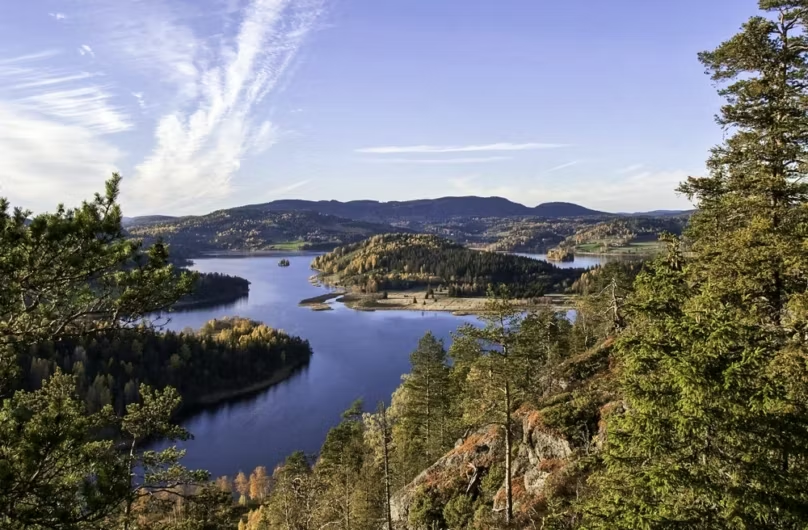
The High Coast provides a natural environment for this kind of development.
It gives the platform a place-based foundation that connects health, nature, diagnostics, products, hospitality, and regional identity.
A convergence of factors
Individually, these trends are not new.
What is new is their convergence:
• diagnostics are becoming more accessible
• longevity science is becoming more structured
• health data is becoming more available
• prevention is becoming more important
• consumers are seeking long-term health strategies
• environments and destinations are becoming part of health experiences
• partners across sectors are looking for new models
Together, these changes create the conditions for a new type of longevity platform.
Early but timely
This space is still early.
There are still few fully developed models that:
• integrate multiple biological systems
• connect diagnostics with lifestyle and nutrition
• operate in a real-world destination setting
• combine science, products, hospitality, and follow-up
• create a structured platform rather than isolated services
That creates uncertainty, but also opportunity.
High Coast Longevity is being developed carefully because the field is still forming. The goal is to build a model that can grow with the science, rather than overclaim ahead of it.
Summary
The timing is defined by several forces coming together:
• a shift from treatment toward prevention
• new capabilities in diagnostics and data
• rising interest in longevity and healthy aging
• demand for more structured health guidance
• growing relevance of place, recovery, and experience
• the absence of fully integrated longevity models
This combination makes it possible to build something new.
High Coast Longevity is being developed to meet this moment with a grounded platform approach — connecting science, diagnostics, nature, nutrition, partnerships, and long-term health.
Explore the broader opportunity
The timing is one part of the picture. The opportunity also depends on how longevity is becoming a new category across health, science, products, and experience.